
Royal Enfield
Classic 350
Why won't the motorcycle start after sitting for two years with a newly replaced battery?
Translating technical record...
When a motorcycle fails to start after sitting dormant for two years—even with a fresh battery—the issue is almost always caused by fuel degradation, fuel delivery failure, or secondary electrical connection issues.
1. Stale Fuel and Fuel System Clogging (Most Likely)
▼
Modern unleaded petrol begins degrading in as little as 30 to 90 days. Over two years:
- Degraded Fuel: The volatile compounds in the fuel evaporate, leaving behind a varnish-like residue that will not combust properly.
- Clogged Fuel Pump & Filter: The internal fuel pump strainer and filter often gum up, preventing the pump from priming or building sufficient rail pressure. Listen closely when turning the ignition and engine kill switch ON: you should clearly hear the fuel pump buzz/prime for 2–3 seconds.
- Clogged Fuel Injector: Varnish blocks the injector pintle or orifice. Even if fuel reaches the rail, the injector cannot spray the required atomized mist (764).
Action: Drain the fuel tank completely. Inspect the inside of the tank for rust or varnish. Flush the tank, pour in fresh fuel, and clean or replace the fuel pump strainer and injector if gummed up.
2. Electrical & Safety Interlock Pre-Checks
▼
Even with a new battery installed, several baseline electrical conditions must be met:
- Terminal Connections: Verify the battery terminals are clean and securely torqued (tighten the M6 hex bolts) (113).
- Proper Voltage: Verify the new battery is fully charged. Open circuit voltage across the terminals must be greater than 12.0 V (ideally 12.6 V–12.8 V) (542).
- Blown Fuses & Relays: Check the main fuse and the fuel pump/starter relays located inside the side panel. Contacts can corrode over extended storage.
- Safety Cut-offs: Ensure the bike is in neutral, the side stand is up, the clutch switch is functioning, and the right handlebar kill switch is toggled to RUN/ON.
3. Spark Plug & Ignition System
▼
- Fouled Spark Plug: Remove the spark plug to inspect for corrosion, fuel fouling, or heavy carbon deposits.
- Spark Test: Ground the threaded outer body of the spark plug against the engine cylinder head and crank the engine. Check for a strong, consistent blue spark. Replace the plug if the spark is weak, yellow, or absent.
4. Crankshaft Position Sensor (CPS) & ECU Checks
▼
If the fuel pump primes and the engine cranks strongly but there is neither spark nor injector pulse:
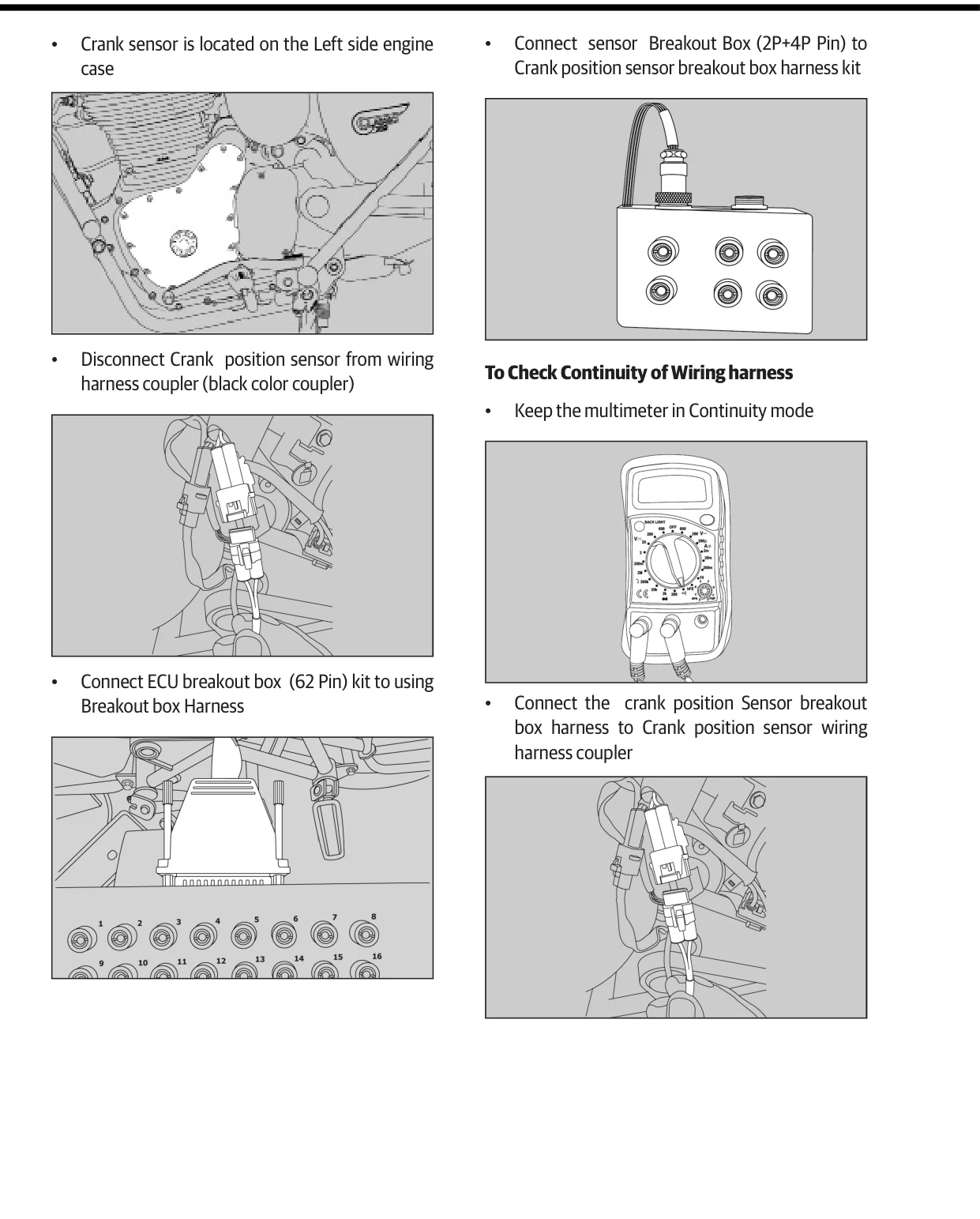
- Check the Crankshaft Position Sensor (located on the left side of the engine case) (858).
- Using a multimeter set to resistance mode (200 Ω), check the resistance across the CPS coupler pins:
- Standard Specification: 205 to 225 Ω at 25 ± 5°C (859).
- If the reading is open or out of specification, the ECU will not know engine position and will inhibit both ignition and injection.
WARNING Never crank the starter continuously for more than 5 seconds at a time. Allow the starter motor and battery to rest for 15–20 seconds between attempts to prevent overheating the starter motor.



💬
Comments
(0)
Write a comment...